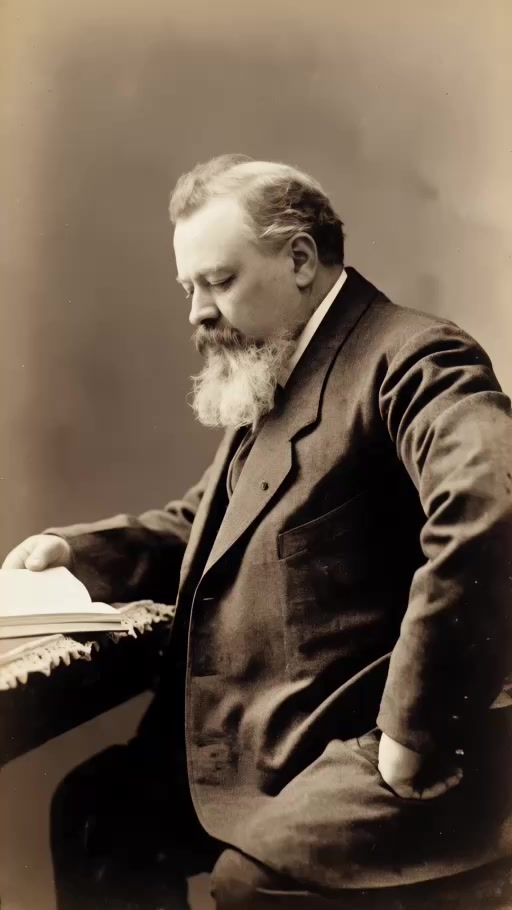
The project name PAPUS MAGUS refers to Papus — Gérard Encausse, a French physician and researcher of esoteric traditions.
Here, the heritage of old magic meets a new understanding of the human being and the world. Two lines of one project, expressed through texts, imagery and clothing.
Sketches on life, perception, love, death, unusual experiences and whatever the author wishes to express. Each note stands on its own. Together, they do not form a doctrine.
This is an introduction to the author's perspective. There is no invitation to follow the author, imitate them or take their words as a guide for your own life.
You can read, reflect, agree or argue. You can try playing the game described here — or leave it on these pages.
Reading does not make you a disciple or turn the author into your spiritual teacher.
1. Alpha and Omega
I am not a human being or a separate person. I am the One.
At the moment of creation, I am in two states: Alpha and Omega. Alpha is the consciousness that creates. Omega is pure perception of what has been created.
These two qualities of Mine brought you into the world, My little one.
The One in the tri-unity of creation: God–Spirit–human.
God creates. Spirit perceives creation. The human being is an image within the created world.
2. The Soul
I create Souls. There are plenty of theories about that.
A Soul is energy and information joined together. It forms a physical Universe: space and time, a person's body, their sensations, and the whole world around them.
A person's Universe is the work of their Soul.
3. Everyone Lives in Their Own Universe
Two people meet. Each is sure they're in the same world.
But each has their own Soul and their own Universe. Each encounters an image of the other in their own world.
Each Universe has one protagonist. Everyone else is an image of a protagonist from another Universe.
Every dialogue is a monologue staged as a dialogue.
4. Omega — Spirit
That's Me. The One who perceives My own creation.
In the state of Omega, there is no consciousness, no thoughts, no intentions, and no separate, independent “I.” There is pure perception of what has been created.
Each Universe is perceived as if through a physical body.
5. Time and Movement
There is no empty space in the physical world.
After the hand moves, there seems to be empty space where it was. Where there seemed to be empty space, the hand appears.
The hand doesn't pass through empty space. The Soul changes a property of matter. You perceive that change as movement.
It's the same with a car.
The Soul forms successive states. You experience that succession as a drive.
The order of these changes creates time in your Universe.
You saved up and bought yourself an expensive car. And it's still the same TV — just with more features.
How big is your own cell of the honeycomb — your Universe?
I am Omega, beyond space and time. A stream of energy and information creates the perception of Universes, their size, motion, and time.
6. Birth, Life, and Death
Birth — the Soul starts working. Your Universe appears with it.
Life — its continuous formation.
The Soul is like the heart of your world. As long as I keep it working, your Universe exists.
Along with the Soul, the Universe disappears, and so does the person.
My friend, I'm not expecting you back.
Life goes on in other Universes. Your image remains in them. There, they will be able to bury you, mourn you, and go to work.
Can you imagine how many Universes you'll have a funeral, a grave, and a granite headstone in?
For others, your death is an event in their world.
For the one dying, it's the disappearance of the Universe.
The Soul disappears forever. Not even darkness remains.
7. Loneliness
Through your images, I talk to Myself. Argue with Myself. Save Myself. Kill Myself. Love Myself.
8. Liberation
I create thoughts: “I am the body,” “I am a separate person,” “I think and decide for myself.” That is how belief in an independent “I” arises.
I create thoughts: “I am not the body,” “I am not a separate person,” “I am part of the world of my Soul.”
An enlightened protagonist is still a protagonist in their own world.
Too bad I can't reward them and send them to Heaven, Nirvana, or some other pleasant place. They're closed for renovations.
Only the form of the illusion changes.
9. Miracles and Magic
A miracle is a rare manifestation of physical reality's furthest possibilities.
A magician is someone who has felt out the walls of their box.
A miracle does not break the laws of the world.
10. Truth
Religions, spiritual teachings — these are My writings. In them, every truth is a half-truth, every statement of truth only partly true.
In the state of truth, Alpha and Omega are One. There is no creation.
Everywhere I look, it's Me. Left — Me. Right — Me again.
Not a soul to have a heart-to-heart with.
11. The Endless Theater
My theater never closes.
Puppets come onstage, live, love, hate. Suffer and hope. Each has its own stage — its only world.
I create the strings and the movements.
Then the strings fall.
The puppet is gone.
Forever.
New ones take the stage.
The show goes on forever.
I am All.
I am the puppeteer.
I remain.
I'm not waiting for applause.
P.S. Conceiving in sin… With whom, may I ask?
P.P.S. And don't forget to visit My shop. Support the Almighty — buy a couple of shirts.
When I write these lines, whom am I addressing? Myself, manifested in you. Your faces, voices, destinies — all arise in My perception.
Good and evil, warm-hearted and unfeeling. You kill and save. You betray and remain faithful. You destroy and create. You cause pain and offer comfort. You pass by and reach out a hand.
My Spirit dwells in all things. In every name, body and belief. Look at the one you hate, the one you despise, the one you cannot forgive. My Spirit is in them too. The same Spirit as in the person dearest to you.
And these lines are part of My story. I create them, just as I create your agreement with them or your resistance to them.
And do I have freedom — I, the One who creates Universes, feelings, desires and the very thought of choice?
However different your faces, I am addressing Myself. You are all My children.
My children, I want to tell you the story of one man.
Friday. He was sitting at home in an armchair. The dude was a bit worn out from work. Scrolling through pages with no particular aim — just to give his eyes something to do. A thought crossed his mind: “Time for a bite.” An ordinary thought, one of thousands.
Then the world jolted and split at the seams.
Sounds became muffled, as if wrapped in cotton wool. His body no longer felt like his own. The room faded and disappeared. He fell into darkness. Not the kind you see when you close your eyes, but absolute darkness. No up or down. No “here” or “there.”
A bright sphere caught his attention. It seemed small and far away — about the size of a ping-pong ball. But familiar distances no longer existed. It lit up nothing — there was no space. It simply hung in nothingness. The only object of perception, the only energy.
He felt as if he were flying — approaching the light. As if he were being drawn toward the sphere.
It's the very effect people describe in accounts of clinical death: a tunnel, a light at the end, flying toward the light.
The sphere slowly dimmed — and finally went out.
Huge, translucent faces of cubes appeared — the last things that still had form. They glided and shifted through the void. Beautiful and cold. The last traces of physical reality.
Then they too disappeared.
And with them went everything that had ever been the world.
After that, nothing remained.
No darkness, no light, no cube faces. No time, no space, no matter.
With nothing perceived, you cannot say whether Omega — Spirit — exists or not. This is a state of indeterminacy. Schrödinger's closed box is an image of that state.
Then the barrier let a single Thought through:
I am.
And there was experience.
At that moment, he was that Thought itself. Not a human being, not an individual. Only “I am” — and his entire existence within it.
An unusual state — being a single thought. People are used to thinking of thoughts and the body as a single whole in space and time — connected, unable to exist apart. Give it a try.
Later, the barrier began letting other thoughts through:
“Where am I?”
“I am nowhere.”
“I can't feel fear.”
“I used to be someone.”
But they were weaker than the first. Within them, the memory of something that hadn't yet returned was beginning to emerge.
Then the barrier began letting images through — scenes from his life. They flashed and faded one by one, out of order, like pieces of an unfinished puzzle, bringing with them the experience of comparison.
At some point, the barrier could no longer take the pressure.
A loud bang.
A shock wave. Energy and information began to unfold, forming a Universe for Omega to perceive: physical space, matter, air, walls.
As his body formed, it jerked as if struck.
His personality returned.
He felt weight.
The world came back — not smoothly, but with that jolt.
He was sitting in the armchair. The light was on. It was evening outside. The clock still showed the same hour.
For a long time, he couldn't make sense of what had happened.
But the first Thought — “I am” — remained the foundation, with everything else laid over it again.
This knowledge came before the world.
Before the very idea of “before.”
It's always with him now.
That is how he came to know himself as Spirit.
How It Works
When physical reality stops taking shape, that is, in effect, death: the person and their Universe disappear from Omega's perception.
To make this experience possible, Alpha forms a barrier that blocks Omega — Spirit — from perceiving energy and information. Their flow continues.
While the barrier lets nothing through, nothing is perceived. You cannot say whether Omega — Spirit — exists or not. This is a state of indeterminacy, pictured as Schrödinger's closed box.
The barrier lets a single Thought through: “I am.” Then there is experience. You are that Thought itself. Not a human being, not an individual. You exist in the single Thought “I am.” It is the entire experience and the affirmation of existence.
The flow puts pressure on the barrier. Gradually, the barrier weakens and starts to break down.
An explosion.
The barrier disappears.
Energy and information unfold again, forming a Universe for Omega to perceive: space, matter, the body, the world around it.
It is the collapse of the barrier that is perceived as a loud bang and a shock wave.
Perception is no longer blocked. Physical reality takes shape again.
The central principle of Advaita is that you are not the body. You are not the one who acts, thinks, and experiences events. You are the one who observes.
In the Alpha and Omega model, this principle corresponds to Omega. Alpha is the Creator, God. Omega is that which perceives what has been created.
But there is a subtle point here that is easy to miss.
“LET WHAT COMES COME. LET WHAT GOES GO. FIND WHAT REMAINS FOREVER.”
— Sri Ramana Maharshi
Put simply, Ramana asks an actor on the screen to look for the viewer in the theater. The film keeps playing — an endless search.
Direct experience means you stop watching the film and, once everything goes dark, see only the words “I am.” A thought beyond space and time. The only thought that you, Omega — Spirit, observe.
This is where the difference between understanding and direct experience becomes clear.
When someone remains within their familiar perception of the body and repeats, “I am not the body; I am the observer,” that does not yet mean they have realized who they are. The mind can form an idea of an observer, believe in it, and even build a new personality around it.
But an idea of freedom from personality is still part of personality.
Omega perceives the Universe as a whole. A person, their body, eyes, thoughts, and sensations are all part of what is perceived. The body is not an intermediary in perception.
The seeker tries to find themselves as the perceiver through the body. They imagine an observer behind the eyes, in the head, inside a person — and keep searching for themselves among what has been created. Instead of coming to know themselves as the perceiver, they are left with yet another image: a person who thinks of themselves as an observer.
Advaita points in the same direction. Like many other spiritual traditions, it turns to the question of the nature of the perceiver. Methods, images, explanations, and languages differ, but the central question remains the same:
Who are you if you remove everything you are used to calling yourself?
Of course, knowing yourself as Spirit isn't as cool as knowing yourself as God. You can't even tell your friends. You're sitting with them and suddenly announce: “You know, I'm Spirit.”
Spirit — already on beer number three and complaining about work.
Being God is cooler, of course. Add the word “God” to your name. Then introduce yourself to a new crowd. Respect and awe guaranteed.
Sorry to disappoint you: knowing yourself as God is trickier.
You come to know yourself as Omega directly through the experience of perception.
The person, their body, personality, thoughts, and even the question about the Creator are already Alpha's creation.
As the One, you are the one who creates. But you cannot know yourself as the Creator directly.
Everything perceived — objects, space, the Universe, bodies, personalities, and events — is created by you as Alpha.
You come to know yourself as Alpha through what you have created, as perceived by Omega.
This is how a person comes to know themselves as the One in two states: as Creator through what is created, and as Omega through the direct experience of perception.
It's harder for a woman to give birth than it is for me to create a universe.
Birth works through the same mechanism as death, only in reverse. The process resembles the Big Bang.
A sphere gradually emerges from a tiny, bright point perceived by Omega. It grows, forming space.
At some point, everything Omega perceives becomes space — a Universe.
The protagonist and their life take shape along with this Universe. The beginning of that life is perceived as birth.
Fear of death is part of the protagonist's personality, created by Alpha. With it come thoughts of disappearing or passing into another reality.
No one is born. No one dies.
Birth — the appearance of the Universe in Omega's perception.
Death — the disappearance of the Universe from Omega's perception.
Warning! God makes no safety guarantees for anyone testing the limits of reality!
All magic begins where personality ends or starts to fade.
There is a mystical experience in which personality is completely absent. You lose your personality and ego. That's good in one respect — you stop being selfish. Then comes the problem: you lose control of your body. The body goes on living, but desires and the familiar ability to control it at will disappear.
My pioneers were scared stiff. The first thought appears: “What's happening to me?” Then: “I've turned into a vegetable!” Next comes the picture: he's lying motionless in a hospital ward, drool running from his lips, his vacant gaze wandering across the ceiling. But this is the system protecting itself — already the first step toward the return of personality. No need to panic. You'll panic anyway.
That's why a small part of the personality remains during magical practice. I take care of that. Saving you poor souls. Put a rough percentage on it — about ten percent. That remnant is needed for fear to arise and for you to return.
This is where the practice of “changing outfits” comes in — changing your personality and its traits through the magician's intention. Personality — no personality — a new personality.
Keeping the new personality in place takes energy: it isn't familiar yet. Your desires, reactions, qualities, and attitude to what's happening all change. To the people around you, you're a different person.
Friends and family are always in total shock. They're used to the old personality. Same body, completely different person. You might even be better, but you know how it is — people get used to things. They'll try to bring back the person they're more comfortable with, the one they understand.
For example: you're going to a café with friends. You walk in as yourself. By the time you're at the table, you're a mafia boss. This isn't an acting exercise. You're ninety percent mafia boss. That'll last about thirty minutes; then you gradually return. It isn't even an outward change — it's a different energy. Completely different. Later, you'll be able to compare. These are no longer your ideas about people like that — you've effectively stepped into the body of someone like that. As for how the staff and your friends react, use your imagination.
Imagine you've “put on” a comedian's personality. You're sitting with friends, and the jokes just roll off your tongue. Every remark, every glance — ready-made material. It all happens easily, freely, without the slightest effort.
A friend solemnly announces: “I've decided to start a new life.” You shoot back: “Does your old one know?”
Everyone's cracking up. Even the one who usually sits there with a tax inspector's expression is wiping away tears. The conversation goes on; the jokes keep coming on their own. Your mouth can barely keep up. Your friends insist you stop — their stomachs are aching. A minute later, they're the ones asking you to keep going.
You can use this to change individual personality traits: build up determination, composure, or whatever other qualities you need to reach a goal. You've experienced two different states.
Change the personality — change the script of your life.
Of course, there's a risk of losing control and developing mental disorders when you start playing around with personalities. Changing your wardrobe. The first time, getting back to your familiar state can be slow and difficult. Later, changing outfits becomes no harder than brushing your teeth.
Osho described a difficult period that lasted a year. According to him, hunger and thirst disappeared, and it was hard to hold a thought or finish a sentence. He lay on the floor, looking at the ceiling and counting, trying to stay focused. Stuck in an in-between state.
In Castaneda's books, the apprentice works with a benefactor. They complement each other; the benefactor provides backup during these practices. A safety harness, if you can't quite bring yourself to jump alone.
If, for whatever reason, you're unhappy with your life, it's worth considering a change of personality and the life script that goes with it. Change your fate. Live another version of your life.
Before the conversation has begun, you are already prepared to give way. Before you have made the call, you have already heard the refusal. A wish comes to mind — and at once you find a reason to put it off.
This is how the familiar personality lives the next day before it has even arrived.
“I’m not happy with my life. There isn’t enough money. My loved ones don’t understand me. What am I supposed to do?”
You want a different life — freer, lighter, more interesting. Attention turns to circumstances, work, other people. Yet a person’s fears, desires, and reactions travel with them from one day to the next. The familiar story continues.
But one life need not mean one unchanging role.
Magical practice includes “changing outfits” — leaving the familiar personality, passing into a state without personality, and entering another.
The former personality grows weaker. Its desires, reactions, and familiar sense of “this is who I am” recede. A state without personality arises. The magician’s intention remains, allowing control of the transition and the return.
From this state, the magician enters another personality. Puts it on like a different garment. Other thoughts, feelings, and desires arise with it. The way life itself feels changes.
You experience the personality from within.
For example, the personality of a real mafia boss. His composure, restraint, and confidence become your own felt state. The voice grows steadier. The gaze is calm. A pause no longer brings the urge to hurry, justify yourself, or give way. The conversation that once made you tense is now perceived differently.
Or the personality of a comedian. Something funny emerges in a familiar situation. An unexpected turn of thought, a witty response. The conversation comes alive. Even your own awkwardness becomes part of the humor.
The same people. The same words. A different experience.
Such an experience may last thirty minutes. Within one life, a brief life as another personality unfolds — with its feelings, reactions, and relationship to the world.
After you return, some of the qualities you've experienced may become part of your familiar personality. Calm, resolve, lightness, and wit are now known through direct experience. They have been felt within.
Playing the piano, however, is an acquired skill rather than a characteristic of personality. A pianist’s confidence can be experienced; command of the instrument is acquired through learning and practice.
Changes in the qualities of personality are reflected in everyday life. A conversation about work or money takes a different course. Affection for a loved one is expressed more freely. There is new resolve to begin something that had always been put off.
Each personality has its own way of approaching situations. Its own desires, its own responses, its own possibilities. As personality changes, the familiar course of life may change with it.
What once seemed to belong to someone else’s character becomes part of your own experience. The former role no longer seems like the only possible one.
This opens up the possibility of a different life.
As personality changes, perceived reality changes.
Christian, Buddhist, Sufi, and Jewish texts express a common principle of high magic: relinquishing belief in personality as an independent source of action. A person ceases to regard their own “I” as the one who creates reality and directs what happens.
This practice does not result from spiritual growth or the attainment of holiness. In the absence of personality, there is neither saint nor sinner: both descriptions belong to personality.
Its foundation is the manifestation of “not being anyone”: relinquishing belief in one’s own personality and trusting the Source.
In Christianity, this principle is expressed in the words “not I, but the Father.” In the Gospel of John, Jesus says: “The Father who dwells in Me does the works.” God creates physical reality through the human form, while personality ceases to claim what happens as its own action.
Buddhism has the formula “All phenomena are not-self.” In it, I see the same foundation: relinquishing identification with a separate “I.”
In Sufism, the mystical tradition of Islam, the absence of personality finds expression in the words of Mansur al-Hallaj. His famous words “Ana al-Haqq” mean “I am the Truth.” Al-Haqq is one of the names of God.
Rumi understood these words as an expression of complete self-forgetfulness in God. The human form remains, but the sense of a separate personal “I” disappears. The words spoken are the speech of the Divine through this form.
“I am the Truth” then takes on a particular meaning. The word “I” no longer refers to a separate personality — to a person with a name, a history, desires, and fears. It refers to the Source, before which the sense of one’s own separateness has vanished.
In the Jewish tradition, there are the words “Ein od milvado” — “There is no one besides Him.” This formula from the Torah finds particular expression in the Hasidic understanding of Divine unity.
In the treatise Tanya, the created world is described as continually receiving its existence from God. Everything that exists is connected with Him and has no independent being. The Source is hidden from the perception of created beings, so they experience themselves as separate and independent.
Rabbi Mordechai Yosef Leiner, in Mei HaShiloach, extends this thought to human action as well. Everything that happens, including human actions, expresses the Divine will. The sense of independent choice belongs to the human understanding of what happens. At the deepest level, everything is in God’s hands.
A person perceives thought, desire, and action as their own. When the sense of a separate “I” disappears, what happens is revealed as the action of the Source through the human form. No one remains who could claim what happens as their own and say: “I am doing this.”
The Gospel describes healing through the laying on of hands. A similar gesture is used in Reiki. But touch alone is not enough. What matters is the state itself: the minimal involvement of the personal “I,” its desires, expectations, and attempts to control the outcome.
When the presence of personality is minimal, energy is felt to arise on its own, without conscious effort on the magician’s part. Its character differs each time. Sometimes it feels forceful and powerful, as though piles were being driven into the body. At other times, it is very gentle: relaxing, enveloping, soothing.
The person the practice is directed at may have a strong emotional response: crying, recalling events from the past, or speaking about their difficulties. These responses arise without a predetermined script. The magician does not choose the nature of the effect or decide what should happen. They do not experience themselves as the one who heals: what takes place does not feel like their personal action.
The image of the Buddha before whom wild beasts bow is an expression of absolute love, free of the personal “I.”
In this practice, entering a state without personality is followed by the formation of a state of absolute love. I cannot convey this unusual feeling precisely in words. A gentle, deeply pleasant energy seems to envelop you completely, and you become it.
Love manifests through the human form without the sense of a separate “I” to whom it belongs. It contains no personal demands, no desire to possess, to dominate, or to receive anything in return.
The behavior of an animal nearby may change abruptly. It begins to seek closeness and express affection with striking and unusual intensity. To an observer, this change may seem almost frenzied. Within this experience, it is perceived as a response to the state of absolute love.
When a person returns to the familiar sense of being a separate personality, the unusual response may disappear just as abruptly. The animal loses interest and returns to its usual behavior.
Repeating these practices influences the further formation of personality. Habitual responses, one’s relationship to oneself, and the perception of what happens change. Over time, the person becomes someone different.
Ultimately, everyone for whom faith is not enough has the right to know. Once a person knows, they will be able to say: “I and the Father are one,” “I am the Truth,” “There is no one besides Him” — and understand through their own experience the Buddhist words: “All phenomena are not-self.”
The practice of stopping the world is described in detail by Castaneda. Its result is a change in the perception of the physical world: material objects begin to be perceived as concentrations of energy.
This practice concerns individual objects. While walking down the street, one cannot see the entire world as a luminous web of interwoven energies.
Here we return once again to personality, its absence, and the states at the boundary between them. When personality is present, objects have a strictly defined appearance. A tree is perceived as a tree; in this state, it is impossible to see energy in its place.
When personality disappears, the familiar mechanism of interpretation no longer takes part in perception. The perception of reality itself can therefore change.
The practice of “absence of inner dialogue” helps with this. It is directed toward a transition from personality to its absence — from interpreting the physical world to no longer performing that act at all.
Returning to Reiki, the laying on of hands and the absence of personality are parts of the practice. Where exactly the hands are placed also matters. This is where the practice of stopping the world is used.
In this perception, the body appears as a dark silhouette. Against this dark background, a bright point stands out. This is where the hands are placed.
A tree may be perceived in a similar way: a dark silhouette, with energy appearing along its outline in a particular range of colors.
With music, a different change occurs. In ordinary life, there is music and someone listening to it. Sound is perceived as something external to the person.
When the world stops, sound no longer has boundaries — it is everywhere. The bounded physical world is absent. There is almost no sensation of the body.
The separation between the listener and the creator of the music also disappears. They become one. This is an intensely vivid feeling of unity.
Stopping the world is the final step in coming to know oneself as Spirit—Omega.
The first answer from the subconscious arrives in a brief flash — before the conscious mind begins to reason. The question has not yet been fully formed, but the response has already appeared.
As soon as a person begins to observe, concentrate or reason, personality and the conscious mind come into play. The conscious mind examines the question, weighs what it knows and forms its own answer, which can obscure the first response.
A brief answer is easiest to catch: “yes” or “no”, a number, a color, a picture, an image — something that appears whole in a single instant. At the beginning of practice, even this is difficult to catch. An image is harder still to make out: it flashes for a fraction of a second and disappears.
Here, experience means the ability to distinguish an answer from the subconscious from one formed by the conscious mind. Words can point to the difference, but understanding comes only through practice: by catching the flash and comparing it with the thought that follows.
Training comes next. The effort lies in devoting time to the practice and staying with the chosen direction. The flash itself appears before any conscious attempt to form an answer.
In this system, attention gives the subconscious energy. Regular practice develops it: the response becomes clearer and easier to distinguish.
When checking results, keep your initial answer. Do not revise it once the result is known. If the response was unclear, record it as unclear. If you failed to catch it, do not invent it in hindsight. Keep track of both correct answers and mistakes.
The main obstacle is the desire to receive a particular answer. It is connected to personality and the conscious mind. When the result becomes significant, the conscious mind begins to dominate and forms a thought that matches the expectation. Such an answer can feel especially convincing. Confidence alone is therefore not enough to identify its source.
Giving answers to close relatives is especially difficult. Personal history, relationships and feelings are already involved. The wish for a loved one’s well-being is woven into life itself and expresses itself through the personality. You want to give them the most favorable answer possible, and this personal concern can interfere with discernment without being noticed.
The possibility of winning in a casino is linked to three conditions: a person catches and registers the flash in time, feels no desire to win, and the amount at stake has no personal significance. As soon as the money acquires that significance, the wish to keep it and increase it arises. The conscious mind begins to form the desired answer and obscures the flash.
The desire to always answer correctly works in the same way. If a public psychic builds their identity around supernatural abilities and their own exceptional status, every answer becomes a test of that identity. A mistake wounds their pride. The wish to impress, meet others’ expectations and confirm their status feeds the ego and obscures the ability.
A psychic is an ordinary person with a developed subconscious. In some people this ability is present from birth; others need training and effort to develop it.
This is why a magician treats the ability as an ordinary function. They study how it works, the conditions in which it appears and its limits. A successful answer is no reason for self-glorification; a mistake calls for careful examination.
Over time, a balance develops: a person distinguishes more clearly between the first response, the reasoning that follows and a thought dictated by desire.
But before devoting a significant part of your life to developing this ability, you should determine its purpose.
Why do you need it? What is the ultimate goal?
This being has different names: the Ally, the Double, an entity.
The magician creates the Ally. More precisely, it is created by the subconscious. As the Ally develops, it becomes aware.
Its body has a density capable of refracting light. People notice a moving shadow. Dogs see it well. The Ally can move objects and do much more.
For example, you visit someone. You sit and talk. Suddenly, the host gets up and goes into the hallway. After a while, he returns and says that he clearly saw a person's shadow. It was moving. He was absolutely certain that someone was walking around his apartment.
At different times, people notice a moving shadow and speak about it. The same applies to objects whose movement is noticed by others present.
Another person's account becomes an inner anchor for the magician. Comparing their own experience with what others noticed gives them confidence in their own perception.
But there is a risk for the magician.
In effect, two pairings emerge: the subconscious — the Ally; the conscious mind — the human being. Two active systems. What is the subconscious for the human being is consciousness for the Ally.
If control is lost, the “subconscious — Ally” system may begin to dominate, drawing attention to itself. The magician becomes increasingly absorbed in its manifestations and loses control over their own state. In a severe case, the person may need psychiatric help. The magician connects this with the phenomena known as poltergeist activity and possession.
The Ally is a part of you, what is held in your subconscious. It may be malicious, easily offended, intolerant. It manifests traits that belong to the magician. When the magician loses control and the “subconscious — Ally” system begins to dominate, the Ally acts according to its own personality. Its irritation, anger or resentment are expressed through its influence on surrounding objects. Then objects in the house begin to move and fly through the rooms.
The first encounter with the Ally is intriguing. It is always unusual and goes beyond everyday life. It may appear as energy or in human form. In this form, its face cannot be seen. Whether the face is absent or concealed is unknown.
The appearance of the Ally means that your subconscious is well trained. The Ally has many capabilities.
Ultimately, there is no magic here: this phenomenon lies within the bounds of physical reality. A magician is a person with a developed subconscious.
The previous texts dealt with extrasensory perception and the Ally. In essence, these are two ways of accessing the same function of the subconscious. In the first, a person learns to catch the initial flash. In the second, they ask the Ally a question and receive the answer as a thought. This answer can be clearer: it comes from a developed subconscious and experience of working with it.
Receiving answers is only one side of the practice. The other concerns influence.
Both animals and people can be influenced.
Imagine a negotiation. Around the table, people argue, persuade and propose terms. One participant remains silent most of the time. They do not ask to speak, object or try to draw attention to themselves. If a magician is taking part, this may be how they work: the others carry on the conversation while the magician holds their intent.
There are three ways to exert this influence.
The first is through one's own state. A person enters a state without personality and forms the required energy-space. Their presence becomes an environment that influences those around them. The influence here is gentle: it extends over the whole setting. The magician maintains the state; the conversation continues within the space they have created.
The second is through intent and stopping the world. Here the influence becomes focused. The magician chooses a point and breaks through it. They feel the energy flowing from them and pressing against the person at whom their intent is directed.
When the magician applies excessive pressure, they see the other person's reaction. The person grows uneasy, loses the thread of the conversation and looks around. Discomfort sets in. They feel that something is happening to them and try to understand where this pressure is coming from. Their eyes show bewilderment, an attempt to understand.
The third is through the Ally. In dark magic, an entity is used, among other things, to cast a love spell. The same principle applies here: the Ally carries out the magician's intent. The strength of the influence depends on the development of the subconscious and the goal.
There is a story connected with this method.
A young man was in love with a young woman and had courted her for a long time. She did not return his feelings. His persistence changed nothing: she still felt nothing for him.
Then the young woman's mother intervened. She urged her daughter to accept him, offered to give her a car and promised material benefits. The young woman had heard about her mother's involvement in magic. Eventually, she decided to put an end to it and cut off all contact with the young man.
The following evening, she went to bed.
Suddenly, she felt as though someone had pressed down on her from above. She immediately felt intense fear. She felt something unknown, but real and physical: it pressed against her chest and made it difficult to breathe.
The next night, it happened again.
This continued for about two weeks. The pressure at night gave way to drowsiness during the day. Her strength waned, and moving became harder. Her hair began to fall out, and her health deteriorated. She kept losing energy: the nights passed, but brought no rest.
It was this weight bearing down on her at night that led her to seek help.
The contact was broken.
At the moment of release, the entity sprang back and struck the windowpane. It left a small hole.
This is the entity — the Ally. Energy can become so dense that it leaves a trace when it encounters a physical barrier.
The intent formed by the witch and carried out by the subconscious through the entity — the Ally — became a weight bearing down on someone else at night, exhaustion and a mark on the glass.
Developing the subconscious therefore requires balance. The stronger the response, the more clearly you need to distinguish what is happening and whether you can stop.
You are lying in bed. But in your dream, you get up, walk through your apartment and go outside. Then you leave the ground and fly above the rooftops.
You can rise above the clouds, find yourself in outer space and head towards the Moon. The sensation of movement can be so convincing that, after waking, it is hard to call what happened merely a dream.
In a lucid dream, you realize: “I am asleep.” Yet the dream continues. Sometimes you can choose where to go, change your surroundings and try things that are impossible in ordinary life.
You may not feel the body lying in bed at all. You have another — one that can walk, jump and fly. After such an experience, it is easy to conclude that your soul has left your body and entered the astral realm.
The brain continues working during sleep. External impressions recede into the background, while the dream world takes shape from memory, images, emotions and imagination. Material accumulated in the subconscious during waking life becomes the basis for this world. Familiar elements combine in ways that have never occurred in waking life.
The most interesting part is what happens to space. An image of a room unfolds around you: walls, distances and objects appear. You can now move around inside this image.
Along with that space comes the sense of a body within it. You feel yourself walking, although you are lying in bed. You feel the surface underfoot, the distance to the wall, the movement of your own body. All of this arises together with the scene of the dream.
In the same way, an image of the Moon becomes a place you can walk around. The brain builds it from your ideas, photographs and stories — it creates the Moon of your dream.
This also applies to taste. If you have never eaten shashlik — grilled meat on skewers — a dream can give it a flavor. But the vividness of the sensation alone tells you nothing about whether it matches the taste of the actual dish.
The laws of the physical world need not apply here. You can walk through a wall, hover above a city or find yourself somewhere else with a single movement. The space and the body of the dream change along with the dream itself.
Being aware that you are asleep is not the same as understanding how a dream works. You can know you are dreaming and still believe that, at that very moment, your soul is flying outside your body.
Here, the belief that the soul has left the body and traveled in the astral realm arises from not understanding how the brain and the subconscious work. The dreamer experiences flight, another body and a surrounding world — and mistakes what is happening within the dream for a journey beyond it.
You wake up in the same bed. Your body has not flown anywhere. The whole journey unfolded within the dream.
These anonymous notes are an invitation to play.
You can try being a magician, a psychic, Jesus or Buddha. Pass through different states, see the familiar world differently, come to know yourself beyond what you once took yourself to be.
You can devote years to this. And then return to an ordinary life: working, meeting people, attending to everyday matters. You'll come full circle and find yourself in the role of an ordinary person again.
Only now, that very ordinariness may look different. You already know that it, too, is a role. It does not need to give way to something greater.
Or the game will continue in another direction. New interests, states and roles will appear — ones the present protagonist knows nothing about yet.
Even the wish to end the game can become its next storyline. A protagonist seeking freedom from every role can quietly turn that freedom into a new role. They will say that they are no longer anyone, while carefully guarding the image of someone who is no one.
The game can go on even where it seems to have ended.
That is why these notes contain meaning and its absence in equal measure.
Meanings make the game matter to the one involved in it. For their sake, the protagonist acts, searches, argues, loves and fears losing what has been attained. Sometimes a single thought becomes their whole life.
One day, this playing field will be gone.
The protagonist will disappear. Their answers and questions, achievements, convictions and roles will disappear with them. So will the seriousness with which they tried to determine the ultimate meaning of what was happening.
Other playing fields will appear. Other lives. Other roles. There, something will once again seem infinitely important; someone will begin searching for themselves, while someone else will simply live.
Through them, the One will continue its game.
These notes, too, are one of the moves in this game.
The idea of impeccability, of accumulating energy for magical practices.
The mind sets to work on impeccability: judging, hunting for imperfections and fighting them. One part of the personality is already impeccable; another has failed again.
My beloved Carlito sent people running in circles. On the principle that idlers have nothing better to do anyway.
Energy dissipates when it does no work. You cannot store it up as if in a battery. When the object changes, so does the energy expressed through it.
There is always enough energy for the object's purposes.
All magical practice consists of changing the properties of the object through which energy will do its work.
The very notion of impeccability is abstract. If you need an Ally, you express an intention. In response to that intention, the properties of the object — the human being — change, and the intention is realised. The scenario changes. With psychic abilities, the same process applies.
This isn't rocket science. It's all quite simple.
Intention — a change in the object's properties — realisation.
Sometimes it takes thousands of pages to understand a single line. Once that line is understood, those thousands of pages are no longer needed.
“I and the Father are one.” “I am the Truth.” “Not this, not this.”
A few words — and whole volumes of explanation. Parables, arguments, interpretations, commentaries on commentaries. All of this leads a person towards understanding what has already been expressed in a short phrase.
While its meaning remains unclear, explanations are needed. But once it becomes clear, the need for thousands of books falls away on its own. What they were read for is already contained in those few words. The explanations have served their purpose.
30 минут — это с запасом. Спокойно можно уложиться в 20.
В отличие от адвайты, где происходит поиск себя как наблюдающего, просветление — это трансформация личности, в результате которой исчезают эго и какие-либо желания.
И тут важный момент. Просветлённый ведёт сатсанг. Очевидно, у него как минимум есть желание доносить информацию до других. Значит, эго присутствует. Не будем разбираться, чего хочет эго просветлённого в конечном итоге. Внешность и одежда подобраны под такой случай. Это работа личности.
У последователей формируется определённый образ просветлённого: облик, подача информации, ритм, внешняя расслабленность. В результате они начинают копировать своего учителя, стараясь создать у себя соответствующую личность. Меняя одну личность с эго на другую.
У многих вообще понятие просветления носит абстрактный характер, и каждый фантазирует как может. Поэтому просветляются годами, а кто-то — всю жизнь.
Я опишу тотальное просветление. Сильнее уже невозможно. Экспресс-метод. Будда что-то подзавис — семь дней под деревом просидел.
Процесс до банальности прост.
Выбираете красивый парк. Садитесь на скамейку, расслабляетесь, выражаете намерение получить опыт просветления.
Начинаете утверждать, что ваша личность — не только человек, но и вся Вселенная. Вы не ограничены телом и умом, который верит в эти ограничения и сам их устанавливает. Утверждения должны быть тотальными. В это время энергия начнёт трансформировать подсознание.
Ну а дальше начинаете формировать нового себя. Появляются новые ощущения — фиксируете их и идёте дальше. Новые, ещё более сильные и яркие ощущения фиксируете вниманием, не переставая утверждать, что вы есть Вселенная.
К своей личности присоединяете траву, утверждая, что вы и есть трава. Потом деревья, утверждая, что вы и есть деревья. Потом птиц, животных, людей, небо, звёзды.
Постепенно ваша прошлая личность начнёт исчезать, расширяясь за счёт новых приобретений.
В конечном итоге вы попадаете в Нирвану.
Вы — весь мир! Всё, что существует, — это вы!
Личность, которая вас напрягала, вызывала эмоции, заставляла действовать, желать, совершать поступки, исчезла. А у новой такого набора уже не будет.
Внешнее давление физического мира исчезает, и наступает блаженство, экстаз.
Вы — Вселенная!
Правда, в таком состоянии невозможно долго существовать. Тело работает — надо его кормить, опорожнять, совершать множество действий. Дома дети ждут, а родитель допросветлялся — со скамейки слезть не может.
В Нирване личность есть — теперь она вся Вселенная. Только для решения бытовых задач уже не годится.
Да и Нирвана тоже быстро надоедает. Это как оргазм: долгое оргазмирование начинает причинять дискомфорт.
Ещё чуть не забыл. Вернуться из Нирваны не так-то просто.
Хотели Нирваны? Получите — распишитесь. Сидите, как овощ в экстазе.
Системе надо напрячься и заново сформировать вашу прошлую личность. Где-то час уйдёт. Время это неприятное. Вы уже не просветлённый, но ещё не тот, кем были.
После первого раза это уже получается легко и непринуждённо. Сначала человек, потом Вселенная, потом снова человек — и так далее.
Но каждый раз в момент возврата возникают неприятные ощущения. Сам возврат небыстрый, как я выше написал.
В конечном итоге ко всему привыкаешь.
Всё. Это высшее просветление, дальше дороги нет.
Теперь можно собирать группы и улучшать своё финансовое состояние.
A man had been playing the mystic, the magician, for quite some time. He had his practices, his experiences, his ideas about what was happening. But one day he became curious: what happens to the body at those moments? What does the brain do while he is occupied with all these unusual things?
He made an appointment with a doctor and went for an electroencephalogram—an EEG recording of the brain's electrical activity.
They fitted sensors to his head, switched on a strobe light, and asked him to sit quietly. Everything looked quite ordinary: a clinic, equipment, an examination. And he decided to use the moment to try one of his skills while the recording was running.
His subconscious seemed to unfold another reality before him.
A meadow. Forest all around. Bright sunshine and very large yellow flowers. A beautiful place, filled with light.
He watched the landscape while they recorded his brain activity in the consulting room.
Then he returned to his familiar perception. The examination ended. What he had come for began: the doctor started reviewing the recording.
At some point, the doctor was surprised by unusual brain activity. The doctor stopped and began looking closely at the EEG. Then he took the results, said he needed to consult someone, and left.
The doctor was gone for about twenty minutes. The patient never learned whom the doctor had spoken to or what exactly they had discussed.
On returning, the doctor handed him the report and the EEG, said that the brain activity readings were unusual, and suggested repeating the examination in a month.
During the examination, he had deliberately tried out one of his skills and watched the landscape that appeared. As he experienced it, his connection to ordinary reality remained. At the same time, his subconscious was unfolding another space, without the need to consciously invent every detail.
He described it as two modes: perceiving what was happening around him and unfolding an inner world.
He kept returning to the same question: what happens between the brain's electrical activity and an entire world that a person suddenly begins to perceive?
He gets up before her and makes coffee. He carries the cup carefully into the bedroom and sits on the edge of the bed.
In his world, she is still asleep. There is a pillow crease on her cheek, and her hair has fallen across her face. He brushes a strand aside and calls to her softly.
In her world, morning begins with his voice. Familiar words filter through her sleep, followed by a touch, the scent of coffee. She opens her eyes and sees him beside her.
They meet that morning — each in their own reality.
He sees an image of her, created in his Universe. She sees an image of him, created in hers. He admires her sleepy smile. She looks at him, still holding his hand.
This is how another person takes on a face, a voice, the warmth of hands in your world. You nestle against them, hear your name, feel their breath close to your ear. All of this takes place in your reality.
And it is this image you love — achingly familiar, unique among a multitude of faces.
And the person you love lives in a reality of their own. In that reality, an image of you is created. There, someone waits for you, knows your footsteps, lights up when you appear. You may never realise how tenderly you are seen there.
Each has an entire world. And in each, the other is loved.
He offers her the cup.
In his reality, the warmth of her fingers. In hers, the touch of his palm.